
|
 |
 |
 |
 |
| |
 |
|
| |
 |
 |
| 09.10.2006 |  |
|
1. Tell me how I should evaluate a loudspeaker. What should I listen for? What would make a good test track? I don't have any technical equipment or knowledge. |
First of all, let's define what Harbeth offers and check it's what you're looking for. Harbeth loudspeakers are precision instruments and are used at home and in professional studios. They contribute very little of their own character hence they are of 'low colouration' design. Harbeths have outstanding clarity and naturalness in the critical middle frequencies and a wide dynamic range and are suitable for all types of music at a sensible replay level.
In evolutionary terms, music is a very new invention dating back only 35,000 years or so and is not, in practice, as analytical a 'test source' as one might hope for. Our auditory system has been honed by evolution for the interpretation of human vocal sounds, not music. Most loudspeakers are coloured to greater or lesser extent, and the use of recorded speech is devastatingly revealing of loudspeaker artifacts in a way that music, unfortunately, is not. With some practice you can become really skilled at interpreting recorded voice on conventional loudspeakers so that buzz words like "nasal", "beaky", "quacky" and "honky" become self-evident. Note that these adjectives, often used to describe loudspeaker artifacts, are those associated with the mouth, nose and chest - not of musical instrument.
Alexander Graham Bell discovered at the start of the electric sound age that the 'telephone band' of only about 300Hz to 3kHz was of paramount importance to our ears. Later, when A.M. (long and medium wave) radio was invented, this bandwidth was opened a little for better reproduction of music - but only by a little. So, by definition, the majority of musical energy falls in an audio band equivalent to that of disconnecting the tweeters on your loudspeakers. It also means that the defining quality of a loudspeaker system is not at the extremities of the 20Hz to 20kHz audio band but in the lower-middle through to the 'presence' region: only about one quarter of that full audio band.
You can form at much of your final opinion of a loudspeaker's capabilities before you have played the first note of music if you use male and female speech and vocals as a test source. You don't have to know the real voice in person but it's ideal, of course, if you can make your own test tape of a familiar voice, recorded outside on a windless day with a really good microphone - a subject in itself. Replaying speech backwards, or spoken in an unfamiliar foreign language also breaks the emotional associations between the sounds of the words and their meaning, and aids analysis.
Whilst there are many examples of technically excellent recordings there are few recordings which can be trusted as having captured the bloom and warmth of the performance without processing, equalisation and the use of large numbers of spot microphones to showcase individual instruments. A concert really isn't like that at all: live sound is warm, lush and clean, has a huge dynamic range in reserve, and the instruments intermingle into a floating curtain of sound that is quite unlike most people's impression of home hi-fi.
If you play an acoustic instrument, remember that when you play your own instrument that you are listening in its nearfield. This is a much 'harder' sound than a listener in the audience would experience and it would be tempting for you to select a speaker that mimics that more intense sound. But be sure to switch back to a speech recording again - and you'll reset your internal frame of reference.
Piano can be revealing not only of the big details but the micro detail in the decay as the notes fade into the silence in a large hall. But as with so many instruments, much depends upon the recording. A piano in a small room (or even one in the concert hall with a microphone under the lid, close to the strings), will sound so different to a concert piano, in a big hall with the lid open. Blues, jazz, folk, or 'easy listening' music with simple instruments and vocal is also interesting and revealing of stereo positioning and depth in a different way to large-scale performance with lots happening at once.
Do not use solo pipe organ music to critically evaluate loudspeakers because no matter what problems the speaker may have, the harmonic structure of pipe organ seems to be sympathetic to loudspeaker defects and will tell you nothing about the underlying problems (if any) of the speaker in the middle and upper frequencies. Conversely, brass instruments are really revealing of cone colouration due to their rich harmonic structure, and showcase Harbeth's RADIAL cone technology. Conventional cones soften the transients of brass instruments as you will hear for yourself.
A good salesman will play you recordings that highlight and complement (or disguise?) the characteristics of a particular speaker or recording. Do not be embarrassed about bringing a stack of CDs or disks with you to the hi-fi shop and be sure to make an appointment in advance. You will need lots of time and a good dealer will expect this, and make a date for you.
Above all guard against being impressed because natural sound, as you would hear it in the hall, is not 'impressive' in hi-fi terms except in its lightness of touch and freshness. Good loudspeakers should create a curtain of sound and not push the performers on to your lap. Really good speakers are impressive in the way they reproduce the small details, the micro tones in music, and not by how loud or attention grabbing they are. One of the remarkable characteristics of Harbeth's RADIAL cone technology is that no matter what they are tasked with reproducing, they just don't fog over the details as conventional cones do - listen out for that.
You can find more about the recording process and a detailed analysis of the typical subjective characteristics of hi-fi and studio monitor loudspeakers in our Designer's Notebook Chapter 7: The curtain of sound. Why not keep a printed copy to hand when you evaluate loudspeakers? |
|
|
|
| |
 |
|
 |
 |
| |
 |
|
| |
 |
 |
| 14.12.2006 |  |
|
2. In simple terms, what are the unique design points of Harbeth speakers? |
There is no such thing as a 'perfect speaker' - it all depends what you want the speaker to do for you. Do you want it to spice-up the recording? To give you the immediacy of a front row seat? To project high frequencies with a glass-like cutting edge? A thumping bass end? In that case, I regret to say there is nothing in the Harbeth line-up that will really suit your taste.
We're all about natural sound and we have achieved that by a unique combination of superior drive unit technology, carefully executed crossover design and thin-wall cabinet technology.
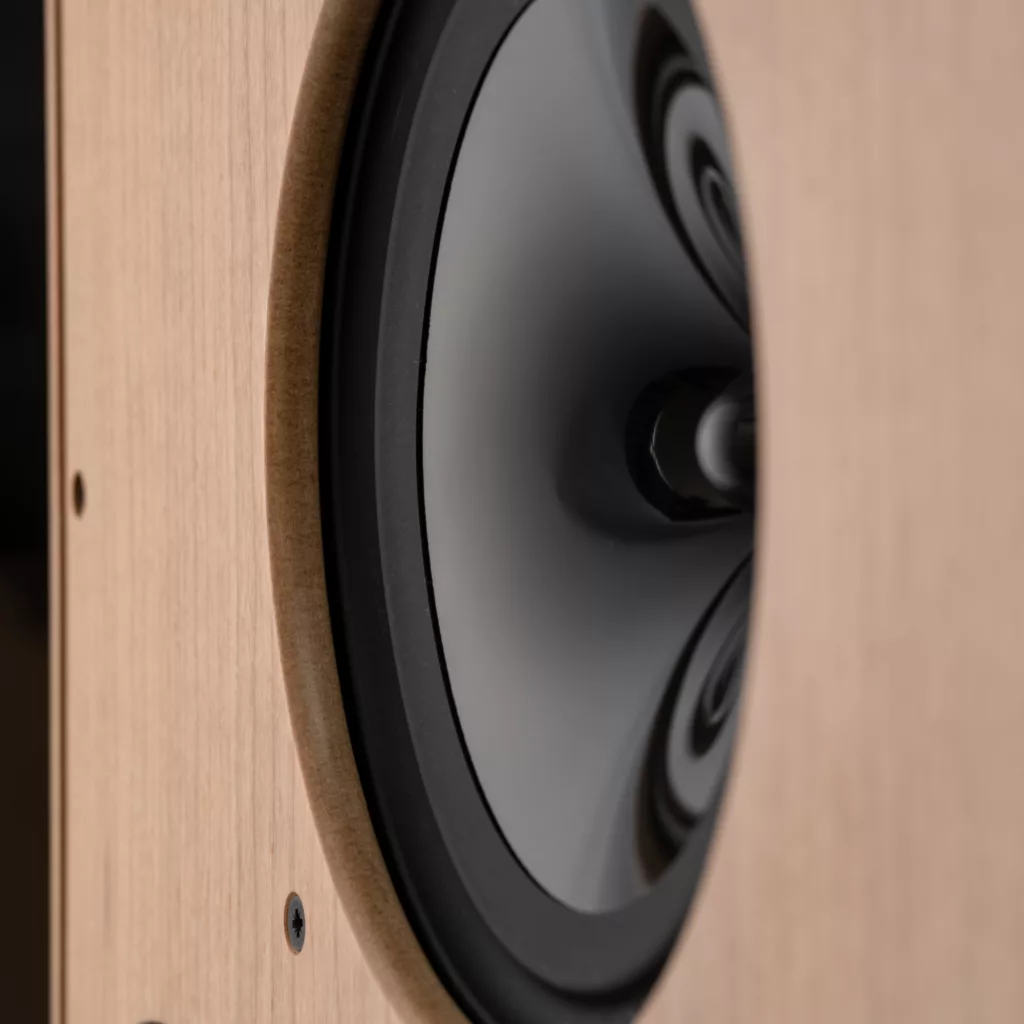
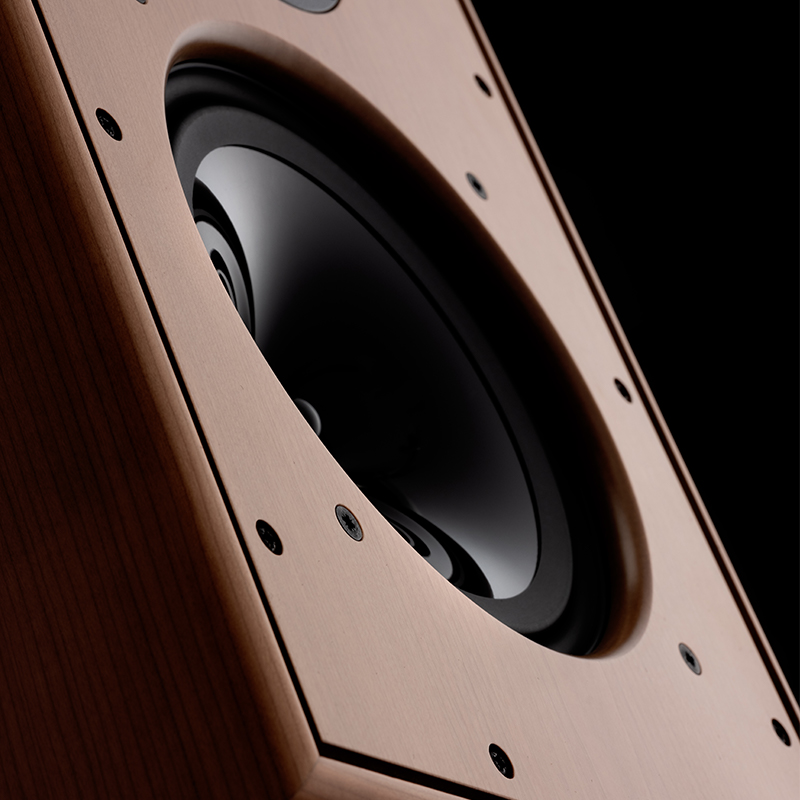
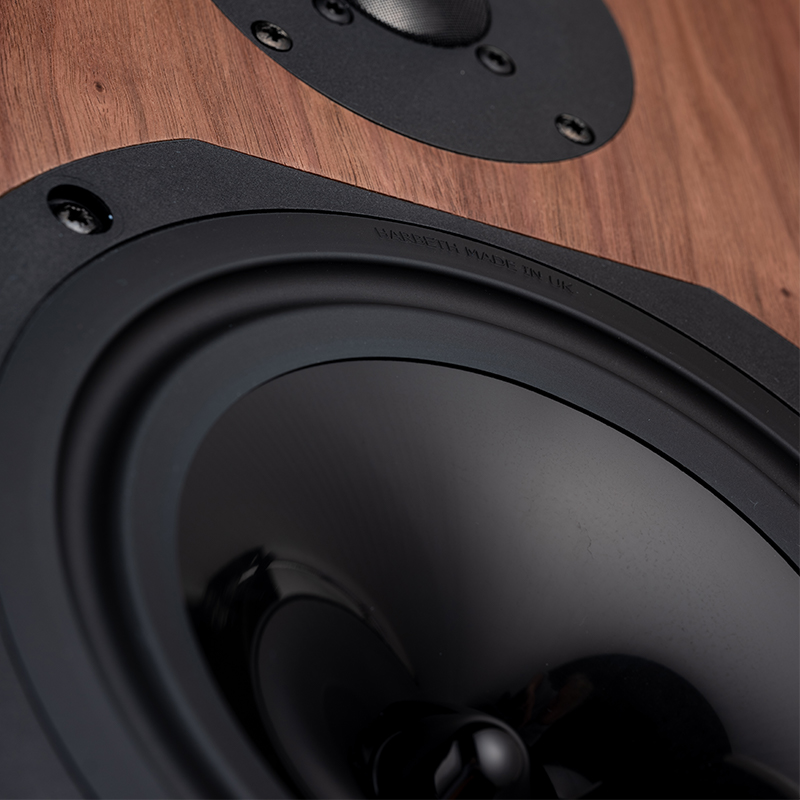
DRIVE UNITS: The Harbeth RADIAL™ drive unit is a masterpiece of clarity and purity of tone. There is no transducer like it - and there is no drive unit that outperforms the RADIAL technology because no other manufacturer has comprehensively investigated the matter of what makes a perfect drive unit. Read about RADIAL™ here.
CABINET SYSTEM: Harbeth cabinets are crafted from thin (typically 12mm) panels which, by virtue of their profile, lend themselves to being internally acoustically damped in a way that is impossible with conventional 'thick wall' panels such as 18mm (3/4 inch) chipboard or MDF. We work harmoniously with the knowledge that the human ear is intolerant of buried resonance in the middle frequencies to steer panel resonances out of the critical band and into the Region of inaudibility.
The 'thin-wall' box concept was thoroughly researched by Harbeth's founder at the BBC and we've stuck with it because it works despite the high cost and difficulty of assembly from individual wood panels - and the cabinetmaker's insistence that we should abandon the removable front and back and go for an 'all-in-one' locked solid cabinet. We could - but it would then NOT sound like a Harbeth.
[See also Q14].
NATURAL REPRODUCTION: Thanks to our speech-based origins in broadcasting, humans are extremely sensitive to the quality of, and energy distribution through, the all-important 'speech band' (see Q1). This runs from about 100Hz right up (and through) the crossover region and beyond into the high frequencies. The importance of making this band sound 'right' (in side-by-side comparison with the original, live sound) is absolutely critical to 'the Harbeth sound', and it is the purity and unforced nature of the way we execute that band that sets a Harbeth apart from all others. A Harbeth has a lightness of touch and clarity without even a hint of hardness - which is, of course, exactly what you would hear at the recording venue.
CROSSOVER DESIGN: It is fundamentally risky to divide-up the audio spectrum and feed it to different drive units such as a bass/min and tweeter. To sound natural, this will entirely depend upon the blending of the sound waves from these two physically different sources in your ear. So, we spend most of our design time adjusting the crossover until the roll-up of the tweeter and roll-down of the bass/mid is seamless, because this is mandatory to fool the listener's ear into believing that he's actually at the recording hearing the sound live.
PLAY AT A REASONABLE LEVEL: Harbeth speakers are deliberately designed to sound just like real life when played at a normal, reasonable level. They do not need to be driven hard and unlike many other speakers that do not need to be pushed to 'come alive'. We have achieved this with an understanding of how the human ear perceives sound and this is reflected in the energy balance across the band. We all have a responsibility to protect our ears and the best way to achieve this is by listening at a normal level and to a sound that doesn't have a character of its own: that's the Harbeth sound. |
|
|
|
| |
 |
|
 |
 |
| |
 |
|
| |
|
|
| |
 |
|
 |
 |
| |
 |
|
| |
|
|
| |
 |
|
 |
 |
| |
 |
|
| |
|
|
| |
 |
|
 |
 |
| |
 |
|
| |
 |
 |
| 06.06.2007 |  |
|
6. What type of speaker stands should I use? |
All Harbeth speakers need to be lifted off the floor and to an operational height by placing them on some sort of stand. None of our speakers will work correctly on shelves or close to nearby surfaces because the sound waves generated by the speakers will be acoustically coupled to (or trapped by) those surfaces, and re-radiated into the room. This will disturb our intended frequency balance of the speakers especially at low and middle frequencies where the speaker is omni directional. It's important to know what we use when designing and measuring our speakers. To achieve a quasi-anechoic measurement of the speaker (i.e. one which is as little influenced by the local acoustic environment as possible) we elevate the speaker high above the ground on a single thin pole. This provides as much air around the speaker as possible. There are many views about the materials from which the stands are fabricated - which could include steel, plastic or wood, as to whether tubular sections should be filled with sand or lead shot whether the stand should be an open-frame or a more enclosed structure. In our opinion, the primary matter is one of safety: whatever stand you select must be stable and must prevent the speaker toppling over, especially when there are children at home. Following that, we would put the height as the next most important factor: getting the speakers as high off the floor as possible and so that your ear is level with the tweeter optimises your listening experience. As for solid or lightweight construction, both approaches have merit depending on whether one wants to contrast the thin-wall cabinet system or to compliment it. We recommend Skylan stands from Canada. Good stands. Friendly people to deal with. You could of course try an make your own, in which case a little detective work as to the optimim height, construction etc. may well be advisable. As for spikes - we go to a great deal of trouble to ensure that the cabinets are perfect, and it never feels quite right to see that spikes between the top of the stand and the underside of the cabinet have punctured the veneer. A small ball of Blue-Tak (or similar) seems a much more elegant solution, but you should experiment. What matters is what sounds best to you. Please read the User Guide on the important subject of stands. To repeat: your stands must be stable. |
|
|
|
| |
 |
|
 |
 |
| |
 |
|
| |
|
|
| |
 |
|
 |
 |
| |
 |
|
| |
 |
 |
| 04.08.2007 |  |
|
8. What do you think about speaker cables? |
The specialist hi-fi cable industry offers the consumer a vast array of solutions to the problem of connecting audio equipment together. This is surely a very good thing. Ignoring cosmetics, there seem to be two main approaches to the design of speaker cables.
One cable design approach involves the deliberate manipulation of the measurable physical properties of the cable (resistance, capacitance and inductance) to alter the load that the amplifier sees. This would maximise the contribution of the cable to the overall sound. We are not really comfortable with this route, since it is surely length dependent and so the sonic results are rather unpredictable. It may well 'spice-up' the sound, but is it right and is it consistent, week in, week out?
The opposite cable design philosophy states that the cable be designed to minimise its contribution to the overall sound, probably by minimising the basic physical characteristics of resistance, capacitance and inductance. This seems a sensible goal to aim at in an audio listening system that is designed to be as neutral as possible. As far as the BBC are concerned, those Harbeths installed there are wired with modest conventional cable and that seems good enough for their purposes.
The best approach seems to us to be experimentation with cables but having a long-term reference to fall back onto, such as humble 79 strand (or similar). Work with your dealer to find the best solution for your unique set-up. |
|
|
|
| |
 |
|
 |
 |
| |
 |
|
| |
 |
 |
| 22.08.2007 |  |
|
9. What is Harbeth's opinion about the environment, ecology and product life? |
There is much awareness of ' the environment' now, but in fact, with our traditional approach, we've been environmentally aware for nearly thirty years. Resources are scarce, and we all have a duty to husband those resources as carefully as we can for the benefit of future generations. It is a primary consideration when designing and manufacturing Harbeth speakers that when used with care, they will be their owners final loudspeaker purchases. It is true that real woods are used for the veneers, but looked at in the long-term, the logs that yielded those veneers have been put to the best possible use on Harbeth cabinets. The same approach runs right through the product: we know that a Harbeth customer buys once (or actually, many buy a second or even third additional pair for other rooms) and our approach is to minimise the risk of breakdown, and maximise your long term pride of ownership. Yes, that could reflect in what is now known as 'over-engineering' but quality always costs a little more. Word of mouth has always been our primary sales route. If you are happy, that enthusiasm will inevitably rub off on others. That is surely how it should be. For the professional customers we offer a Trade-up service which allows us to recycle components to professional users wherever possible. |
|
|
|
| |
 |
|
 |
 |
| |
 |
|
| |
 |
 |
| 20.09.2007 |  |
|
10. What does Harbeth say about 'listening fatigue'? |
Listening fatigue describes the experience that non-Harbeth users report whereby after some minutes, hours or days (depending upon an individuals sensitivity) certain sonic characteristics of their speaker system will become very irritating. Fortunately, the ear is fairly forgiving of mild colouration in the lower registers, but where the ear's sensitivity peaks-up, in the upper midrange and lower treble, even low-level 'buried' resonances can be intensely irritating, whether or not they can be readily identified by conventional frequency response measurement. If the speaker designer is foolish enough to rely on his test equipment at the expense of critical listening then he is in the wrong: the ear must always be the final arbiter of colouration and listening fatigue. Surely the paramount design objective, above all others, must be the avoidance of listening fatigue by whatever design means is necessary and regardless of cost, complexity or inconvenience. A truly high fidelity loudspeaker simply can not and must not sound fatiguing at all, and yet, very many so-called 'studio monitor' speaker are extremely fatiguing to listen to the point of physical pain after just a few minutes even though their first impressions were reported as "enhanced clarity", "exceptional realism" - that experience often reverses after prolonged exposure. Truly natural-sounding loudspeakers do not sound spectacular, except in their contrast to our (negative) preconceptions of how conventional speakers sound. Real-life sound draws attention to itself for its lightness of touch and unforced projection. As has been known for at least 40 years, any serious evaluation of loudspeakers for use in a professional environment must involve extensive confidence building evaluation to be sure that listening fatigue is not detected by any listener under any conditions. Unfortunately, the commercial constraints nowadays has contracted the entire 'loudspeaker evaluation' to a listening exposure of a few minutes, and completely neglected longer term fatigue evaluation with serious overall commercial consequences even underlying Health and Safety issues. |
|
|
|
| |
 |
|
 |
 |
| |
 |
|
| |
|
|
| |
 |
|
 |
 |
| |
 |
|
| |
 |
 |
| 11.10.2007 |  |
|
12. Does the sensitivity of a speaker matter? Many Harbeth's are specified as being about 86dB |
The 'sensitivity' of a speaker system derives from the power of the magnet, the driver's surface area, how far it will move, and the mass of the cone. If the magnet, surface area and excursion are defined, then the only variable that the designer can play with is the moving mass.
There is a temptation to 'spec-up' the sensitivity, solely because of the misplaced perception (in some non-technical quarters) that the higher the dB rating per Watt of input power 'the better'. Thirty years ago, when power amplifies were limited to about 15 or 20W, speaker efficiency was important, but as powerful amps are very inexpensive now, there are far more important design goals.
The moving mass is primarily defined by that of the cone plus its (rubber) surround in approximately equal proportions. The surround acts as a damper, and this could be thinned down or replaced with foam (which disintegrates with time) but the damping effect would diminish, and the cone would not be properly terminated. Hence, we use as much damping as we need, and this fixes the sensitivity. All speaker designers face this dilemma - we put sensitivity as the least important design consideration - and sound quality first. |
|
|
|
| |
 |
|
 |
 |
| |
 |
|
| |
|
|
| |
 |
|
 |
 |
| |
 |
|
| |
 |
 |
| 16.10.2007 |  |
|
14. What is the importance of the cabinet construction, and what is a 'thin wall cabinet'? |
Everything in the universe resonates, and that definitely includes loudspeaker cabinets! Some resonances are rather useful - such as the fundamental resonance of the air mass inside the cabinet which acts as a spring against the bass/mid diaphragm (cone) and when correctly proportioned, permits a good system bass response. Other resonances are not so useful or desirable, but result from Newton's Second Law of motion: 'every action has an opposite and equal reaction'. For example, as the cone moves inward, the cabinet must, by definition, push back against it, and this sets up peaky resonances inside the cabinet structure which are measurable outside the cabinet with suitable equipment.
At the design stage of a speaker system we need to be aware of the contribution of the cabinet walls to the overall sound perceived by the listener, even if not in the system's frequency response curves. At certain frequencies, untreated wood will be so acoustically transparent that sound waves will pass through it from inside the cabinet as if it is almost invisible; at some (and hopefully different) frequencies the combination of the panel's stiffness and mass will encourage it to sympathetically resonate with notes in the music. Taming these panel resonances is extremely time consuming at the design stage, and demands great attention to the smallest details of the cabinet construction, measuring equipment much trial-and-error. Whatever solution one arrives at, the best one can achieve is to suppress a panel's output and/or to steer it into a frequency band where it is either inaudible or benign: this implies at the bottom end of the audio spectrum.
It is self evident that if the 'raw' untreated panel is thin, that damping that applied damping will have a proportionately greater beneficial effect than if the panel is thick, where no amount of conventional surface damping can adequately suppress latent peaky resonances. The superiority (although at very high cost) of the 'thin wall' panel philosophy was invented and used by the BBC from the 1960's, backed up by measurements and Research, and is, to our mind, the best overall solution for an acoustically quiet mid band, where the ear is extremely sensitive to buried resonances. |
|
|
|
| |
 |
|
 |
 |
| |
 |
|
| |
 |
 |
| 22.10.2007 |  |
|
15. Do I need a subwoofer? |
As Alexander Graham Bell discovered when working on telephony, the audio bandwidth for the perfect conveyance of human speech need only be about 300Hz to 3000Hz, (the "midband", equivalent to the medium wave (AM) radio bandwidth) and anything beyond that does not aid intelligibility at all.
Of course, for music we prefer a wider band, but only if the audio quality is clean. Considering 'real' music as opposed to electronically synthesized music, there is very little information below about 50Hz and above about 12kHz as a proportion of the total energy in the music. Typical domestic listening rooms are neither big enough nor well damped enough to allow very deep, clean bass so it is just as well that our ears can fill in the missing bottom end without us having to struggle to reproduce it.
Far more important for the *perception* of a solid bass response is a good output in the 50-150Hz band which can be achieved in almost all rooms even with a small system like the HL-P3ES2/Monitor 20, at a sensible drive level.
Of course, for the 'cinema sound experience', different rules may apply but we are concerned here with the natural reproduction of music, not special effects. |
|
|
|
| |
 |
|
 |
 |
| |
 |
|
| |
 |
 |
| 08.11.2007 |  |
|
16. Do I need to 'burn-in' my Harbeths? |
No: the only component part of a Harbeth loudspeaker that can change as a result of the exercise known as 'burning-in' is the resin-doped cloth suspension that centres the neck of the cone in the magnetic field - sometimes called the 'spider'. Under the microscope, once the resin has been worked, it crazes into millions of small interconnected islands. This process is irreversible and takes only a few hours - or less, with bass heavy music played rather louder than normal. After that, the drive unit can be considered fully aged, and the resonant frequency has settled at its final value and will stay at that value.The ferrofluid used in Harbeth tweeters will become appropriately viscous after a few minutes operation. Neither the coils, resistors, capacitors, cables no any other part of a Harbeth speaker has any short-term ageing mechanism.
As discussed in Designer's Notebook Chapter 7, "When one hears reports of a loudspeaker 'needing an extended burn-in period, maybe hundreds of hours' this has little or nothing to do with the ageing process of the drive units but of the listener attempting to reprogram his fight-or-flight response. At the top of the design specification of all and every Harbeth speaker is that it must not be fatiguing to listen to hence, by implication it must not have an over-vivid phantom image".See also the User Guide section. |
|
|
|
| |
 |
|
 |
 |
| |
 |
|
| |
|
|
| |
 |
|
 |
 |
| |
 |
|
| |
 |
 |
| 10.11.2007 |  |
|
18. What Harbeths do the BBC buy and use? |
Both throughout the UK and overseas in the World Service, the BBC (British Broadcasting Corporation) have purchased and installed Harbeth speakers since 1977. The BBC comprises many business units, each self-accounting and free to employ people and technical resources as they choose according to their budget and needs.
After the ending of a centrally imposed equipment mandate in the mid 1990's and the demise of Rogers, Harbeth developed into the primary long-term supplier of quality studio monitors across the BBC and took responsibility for servicing and maintaining their Rogers LS speakers. The number of installed Harbeths in the BBC has steadily increased in applications which were previously reserved for the BBC's own LS3/5a (Monitor 20), LS5/9 (Monitor 30) and LS5/8 (Monitor 40) monitor loudspeakers.
The Harbeth sound is natural, neutral, uncoloured and extremely easy to work with for hours on end at a moderate listening level, just as were the BBC's own LS series speakers. Other monitors brands have different characteristics.
As at January 2006, the BBC is Harbeth's biggest single UK customer and has the largest installed base of Monitor 40 (active and passive) in the world amongst hundreds of Monitor 20 and Monitor 30 (active and passive), Circle series designed by Harbeth and sold under the HHB brand and Harbeth LS3/5a. Orders are continuously received for BBC installation as the Harbeth application base within the BBC steadily expands. Product performance leads to recommendations and further sales. Harbeth's installed base in ITV (Granada-Yorkshire-Anglia) is increasing.
During any one day, more than 20 million UK listeners and viewers are unwittingly hearing audio mastered on Harbeth speakers along with millions more overseas. For example, when a BBC announcer says that a Network radio programme - perhaps a drama or a concert - was made at BBC Bristol, BBC Cardiff, BBC Belfast, BBC Bangor or others it has been made on Monitor 40s. Likewise in television - countless BBC programmes from Eastenders* to Question of Sport are made on various Harbeths throughout the production. We have lost track of the total installed base now and the application to which they are put so it's always a treat to discover which programmes the Monitor 20/30/40 are used on.
*Setting aside consideration of plot etc. listen carefully to the soundtrack of Eastenders. With a production ratio of 50:1, every one hour of broadcast Eastenders requires 50 man hours of dubbing, and demands total concentration in the studio: fatigue-free monitoring is a must. |
|
|
|
| |
 |
|
 |
 |
| |
 |
|
| |
|
|
| |
 |
|
 |
 |
| |
 |
|
| |
|
|
| |
 |
|
 |
 |
| |
 |
|
| |
|
|
| |
 |
|
 |
 |
| |
 |
|
| |
|
|
| |
 |
|
 |
 |
| |
 |
|
| |
|
|
| |
 |
|
 |
 |
| |
 |
|
| |
|
|
| |
 |
|
 |
 |
| |
 |
|
| |
|
|
| |
 |
|
 |
 |
| |
 |
|
| |
|
|
| |
 |
|
 |
 |
| |
 |
|
| |
|
|
| |
 |
|
 |
 |
| |
 |
|
| |
 |
 |
| 14.12.2007 |  |
|
28. Is DAB or the internet's MP3 a suitable quality format for audio? |
The painstaking one hundred year uphill path from wax cylinder, through 78's, then analogue tape, vinyl, CD and finally DAT steadily improved resolution, lowered noise and distortion and increased playing time. Each generation offered more audio performance. But Digital Compact Cassette (DCC) of the early 1990's confirmed to the music industry that hi-fi enthusiast's resistance to data compression was just a obstruction to commercial progress, easily dismissed and sidelined. From DCC onwards the audio-quality argument had been lost, with each future system offering less quality. Mini Disc became a huge success, extensively used in broadcasting (despite very heavy data compression and worries about encode-decode-re-encode) and that in turn begat MP3. For all practical purposes, consumer audio quality peaked in 1983 with CD. These now are the golden days for audio quality but with CD sales in decline, we can not assume that CDs will always be readily available.
It is extremely unlikely that the audio quality available to the consumer will ever exceed the standard of today's CD, nor, perhaps, does it need to. It is certain that the consumer seems to values convenience - and cost - over absolute quality. LP, at it's best and under ideal conditions also offers a good-to-great quality. DAT, an excellent format was the final uncompressed format but inconvenient and susceptible to damage.
If we take CD quality as our yardstick for "as good as it gets" we can do some simple maths which puts the whole scene in perspective:
The CD-audio format supports two channels. Each channel has a sampling frequency of 44,100 times per second at which a 16 bit data word is generated for each channel.
So, 2 x 44,100 x 16 = 1,411,200 bits of data are generated every second to describe the audio waveform; a data stream pouring off the CD players optical pick-up of 1.41Mb per second.
In round numbers, when you download an MP3 file described as, say, "128k' (=128,000), we can compare that data flow with CD's 1.41Mb/second (=1,411,200). Since 128,000 is less than 10% of 1,411,200 we can say, approximately, that encoding this MP3 file has ignored 90% of the fine detail in the audio master tape. This is justified by the experts who derived the encoding methods behind data compression as information 'not being of significant importance to the musical detail'.
It is most unlikely that DAB is of good enough audio quality. MPEG Layer 2, on which DAB is based, is a early and now virtually obsolete lossy compression system dating back some ten years. It was designed to be of good quality at a bit rate in excess of 192kb, which by today's standards of compressed audio is a high bitrate. Only BBC Radio 3 is broadcast at this bitrate - other BBC stations are at (far) lower bitrates, some as low as 80kb, mobile phone quality.
You can read an objective review of the limitations of the technology behind DAB here and the BBC's stated public position about the balance between quality and convenience here. DAB, just like analogue FM, sharply cuts off all output above 15kHz regardless of bit rate. Therefore, broadcast BBC Radio 3, even at 196kb/sec. has an bandwidth 5kHz less than CD.
The quality of the BBC service over Freeview/satellite has not been critically evaluated, but could, in theory be better (or worse) than that of DAB. In our opinion, despite the excellent user choice and features, the general audio quality of DAB in the UK is extremely disappointing and probably lower, on average, than a good FM signal. DAB should not, under any circumstances, be used as a critical audio source.
Here is an evalation undertaken at the European Broadcasting Union (EBU), including a contribution from the BBC concerning the audio quality of low-bitrate codecs:
www.ebu.ch/CMSimages/en/tec_doc_t3296_tcm6-10497.pdf |
|
|
|
| |
 |
|
 |
 |
| |
 |
|
| |
|
|
| |
 |
|
 |
 |
| |
 |
|
| |
|
|
| |
 |
|
 |
|